
You Already Have a Personal Database
Your phone knows your weight, spending, location, appointments, and taste. The strange part is how rarely you get to see the whole picture.
Most people would never say they maintain a personal database.
The phrase suggests a server rack, an officious spreadsheet, or someone who assigns identification numbers to his socks. It sounds technical and faintly obsessive.
But most of us already have one.
Apple Health knows how many steps I took. My bank records what I bought. My calendar knows where I intended to be. My photographs preserve dates, locations, and faces. Spotify remembers what I listened to. Shopping accounts maintain a history of what entered the house. Notes contain ideas I once considered important.
Taken together, these applications hold a remarkably detailed account of my life. They simply refuse to sit at the same table.
Mowing the digital lawn
I became conscious of this while looking at my phone.
It had become saturated with apps. Finding the one I needed meant moving through screens, folders, and icons whose purpose I could no longer remember. A device designed to make information immediately available had begun to resemble a crowded storage unit.
I reviewed my Screen Time report, moved the applications I used most onto the first screen, and grouped the rest into practical categories: banking, cars, utilities, media.
Then I mowed the lawn.
That is what I call deleting the applications I no longer use. Like cutting grass, it is satisfying, temporarily restorative, and destined to be repeated.
The cleanup made the phone easier to navigate, but it exposed the larger problem. I did not necessarily have too much information. I had too many small territories in which that information was trapped.
Every app wanted to be a destination. What I wanted was a view.
It began with scraps of paper
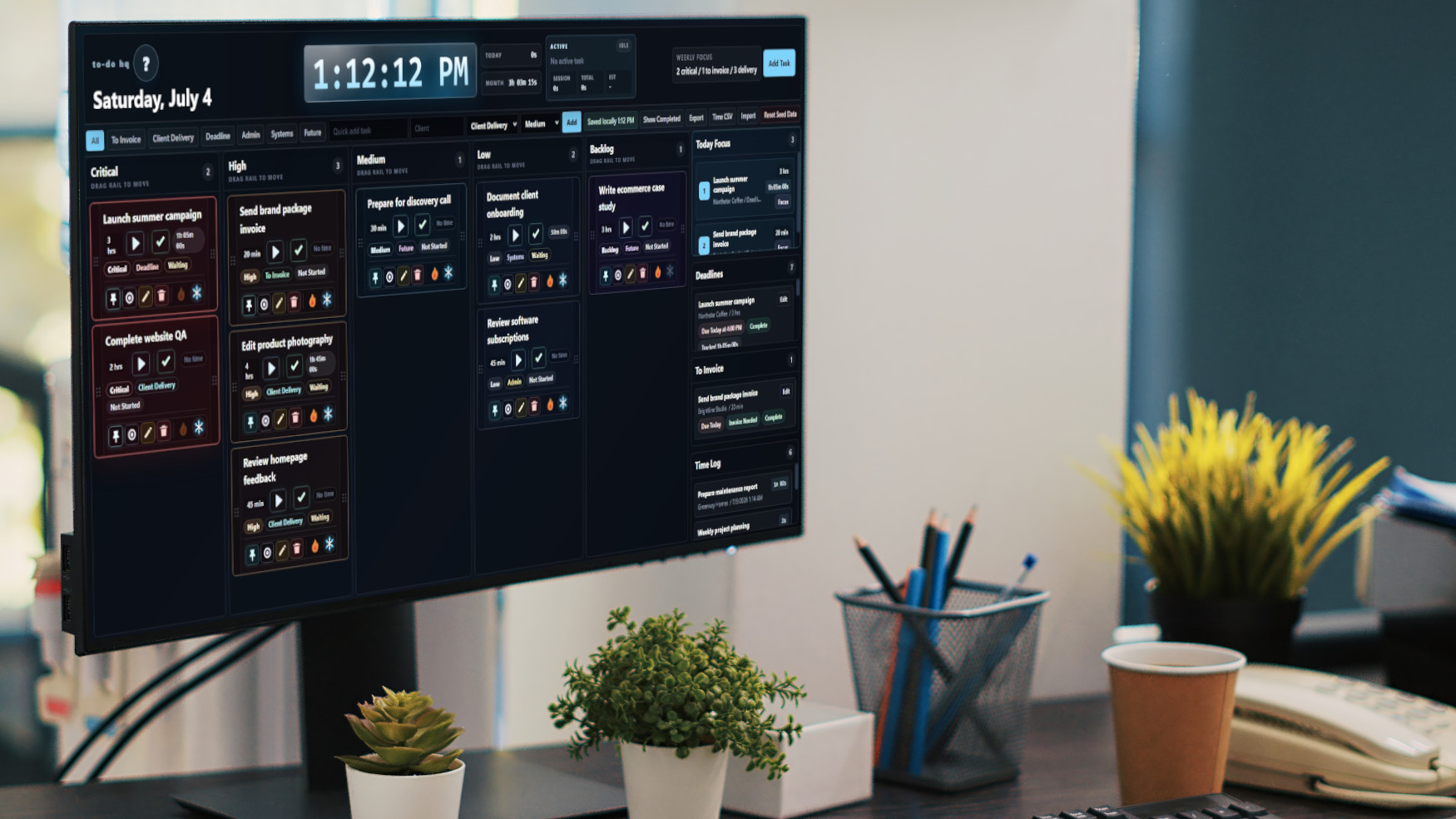
Around the same time, I had been building a private application for myself.
It began as a response to the loose paper on my desk: envelopes with reminders written across the back, incomplete lists, notes from telephone calls, and ideas that seemed indispensable when I wrote them and mysterious three days later.
I had tried conventional task and note-taking products. They worked, but they came with someone else's assumptions about how work should be organized. Eventually, I built something simpler around my own habits.
Once the notes had somewhere useful to go, the application expanded.
I added task tracking. Then I began recording my weight and displaying it on a graph. A single measurement says very little; a line moving across several weeks tells a story. Putting it beside step data seemed useful. Calorie tracking followed, although that quickly demonstrated how a modest private tool can begin behaving like an enterprise software project.
Each addition raised the same question: What information becomes more useful when placed beside something else I already know?
That is a better question than asking which app I should download next.
We track more than we understand
People clearly enjoy knowing things about themselves.
A Pew Research Center study found that seven in ten American adults tracked at least one health indicator, including weight, diet, exercise, or symptoms. The study used data collected in 2012, so its technology figures belong to another era. The behavior is more interesting than the devices: many respondents kept information in their heads or on paper, while only half maintained an organized record.
Read the Pew Research Center study
People like tracking. They are less enthusiastic about maintenance.
That distinction still describes our relationship with personal data. Phones and watches have made collection nearly effortless, but the result is often a large quantity of information without a common structure.
Your sleep belongs to one company. Your workouts belong to another. Your purchases, appointments, photographs, reading, and unfinished ideas occupy separate systems. Each application knows one version of you.
The four levels of personal data
There are roughly four levels to this arrangement.
The first is passive collection. Phones, watches, and services record activity without requiring much thought from the user.
The second is deliberate but specialized tracking: weight, workouts, expenses, food, sleep, medication, or tasks. Each category receives its own application.
The third is a personal organization system. This is the person who begins connecting projects, notes, goals, finances, health, and ideas using spreadsheets, Notion, Obsidian, Airtable, or software of his own.
The fourth is the full life database: a structured system combining health, work, possessions, finances, travel, documents, and knowledge.
That final level is impressive, but it can also become its own form of madness. Not everything improves by becoming a field in a table.
The private ledger
The idea of recording one's life is not new.
People have always kept ledgers, journals, workshop notebooks, household accounts, training logs, calendars, and correspondence. These records helped them remember obligations, understand progress, and avoid repeating mistakes.
The modern difference is that our records are more detailed and less unified.
We create enormous quantities of personal information, but most of it is organized according to the commercial interests of the software collecting it. A fitness app wants fitness data. A bank wants transactions. A streaming service wants listening history. Each provides a polished view of its own territory, but none is particularly concerned with the whole person.
A personal database restores some authorship. It lets the owner decide which categories matter, what should connect, and what deserves to be forgotten.
More data is not more discipline
The temptation, once such a system exists, is to track everything.
Weight leads to calories. Calories lead to protein, water, sleep, mood, and exercise. Before long, breakfast begins to resemble a quarterly filing.
This is not necessarily self-knowledge. It may simply be administration.
A recent systematic review of personal-informatics research found that tracking can introduce cognitive burden, emotional consequences, practical difficulties, and unhealthy changes in behavior. Data can clarify, but it can also produce guilt, fixation, and another set of obligations.
Read the personal-informatics research review
A useful personal database should therefore be selective.
- Preserves something I would otherwise lose
- Reveals a meaningful pattern
- Improves a recurring decision
- Removes repeated friction
If it does none of those things, it probably does not need to be recorded. Restraint is part of good system design.
Data about you is not necessarily yours
There is a difference between information being about you and information belonging to you.
Commercial platforms offer convenience, polish, and synchronization. I have no intention of replacing every useful service with software built in my spare time.
But a private system changes the relationship.
I decide what enters it. I decide what connects. I can change the interface, export the information, or remove a category that no longer serves me. The system does not need to increase engagement, sell a subscription, or manufacture a reason for me to return tomorrow.
Researchers have explored personal data stores as an alternative to the corporate model: private systems that give individuals more control over how their information is stored, used, and shared. The technology remains complicated, but the appeal is straightforward.
Read the review of personal data stores
Control also creates responsibility. Combining health, financial, professional, and personal records increases the consequences of poor security. A serious private ledger should be treated like one.
The goal is not to gather everything. It is to keep a few important things in a place that answers to you.
An audience of one
I am not attempting to build a digital replica of my existence.
I want fewer scraps of paper, a clearer view of my work, and a useful record of the things I am already trying to improve. I want to see information without remembering which company's application contains it.
That may be the more interesting consequence of personal software.
For decades, databases have been things institutions maintained about us: employers, banks, hospitals, retailers, governments, and technology companies. It is now becoming practical to construct smaller systems for ourselves.
Mine began with notes. Then came a graph. Then came the realization that I already had a personal database.
I just wanted one that reported to me.

Got a take?